




SF Zoo working in partnership with Mexican Wolf Recovery Program
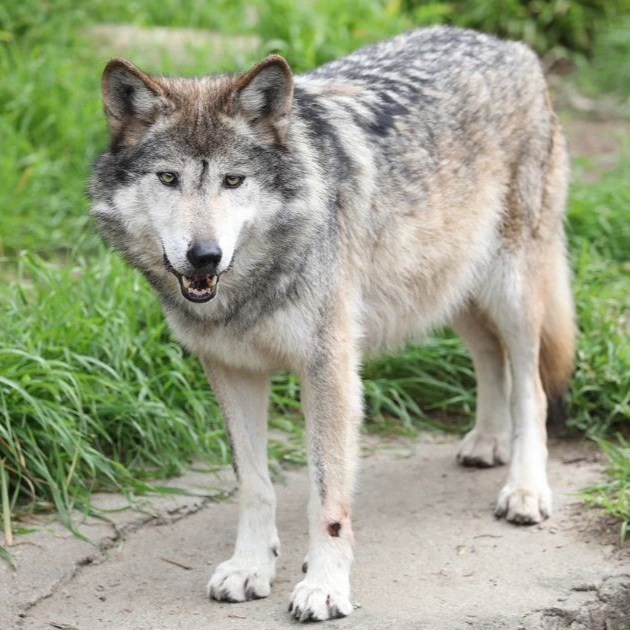
The sight of Mexican gray wolves in their natural habitat is a rarity, as these small wolves are nearly extinct in the wild. The San Francisco Zoo plays a pivotal role in their coThis is Lobo Week, which was designated to celebrate the recovery of the Mexican gray wolf, also known as “El Lobo,” the world’s most endangered wolf subspecies, and one that has made a remarkable recovery after near extinction 50 years ago. Since 2016, San Francisco Zoo & Gardens has served as a permanent holding facility for captive-bred wolves in partnership with the Association of Zoos and Aquariums’ Mexican Gray Wolf Species Survival Plan and the Mexican Wolf Recovery Program led by U.S. Fish and Wildlife Service. The Zoo was recently been given the green light to breed “Alpha,” one of its four seven-year-old female siblings.
“This is really huge for this subspecies,” said Tina Hunter Burnam, Curator of Carnivores. “By breeding Alpha, her pups would eventually be released into the Mexican Wolf Recovery Area, essentially, contributing to the wild population and the re-establishment of this rare subspecies.”
This week, SF Zoo was safely transferred Alpha to ABQ BioPark’s Wolf Conservation Center in New Mexico, which has a viable male. As part of the program, Mexican gray wolves are kept “wild,” in that they are not trained, nor do animal care staff interact with them in the same way as they would other Zoo animals. This allows this particular subspecies to be eligible for release into the wild, should the occasion arise. SF Zoo previously kept three non-releasable senior wolves as part of the program, and in 2018, became home to the female siblings born at the California Wolf Center. The foursome has been part of on-going health studies, with the possibility of future breeding on behalf of the program, and whose time has now come.
When born, the pups will be fostered into one of the wild packs and released in what is known as the Mexican Wolf Experimental Population Area (MWEPA), located in the southwestern U.S., specifically, the Blue Range Wolf Recovery Area, which is made up of Gila National Forest in New Mexico and the Apache National Forest in Arizona. The area is managed by U.S. Fish and Wildlife Service.
“I am very excited to be part of the bigger picture with this program,” said Hunter Burnam, who serves as a member of the Canid and Hyenid Taxon Advisory Group Steering Committee. “This is one of the reasons I got into this field 35 years ago.”
Though they were once abundant throughout Mexico and the Southwestern United States preying on native elk and deer, Mexican gray wolves were nearly fully extirpated by the 1970s by livestock ranchers, hunting, trapping and poisoning. When the population went down to only seven individual wolves, putting the species at high risk for extinction, zoos were able to offer a hand to help save the species. In 1976, Mexican gray wolves were designated as an endangered species. From the seven rescued wolves bred in captivity, 11 wolves were subsequently released into a small, protected pocket of Arizona and New Mexico. These 11 wolves are currently responsible for repopulating the approximate 286 that now live in the wild and about another 380 wolves in managed care like the ones at SF Zoo.
The numbers, while remarkable given how close the Mexican gray wolf was to extinction, has not kept wolves in general from being thought of as “villains,” and they continue to be exterminated at a high rate. In 1995, wolves were taken off the Endangered Species List because their numbers increased, but instead of managing wolf numbers, permitted hunts where wolves are prevalent, in Idaho and Montana, are cruel and more weaponized than ever, and aimed at eradication.
“We support relisting the wolf to the Endangered Species List,” said Hunter Burnam. “For the future of these incredible animals.”