





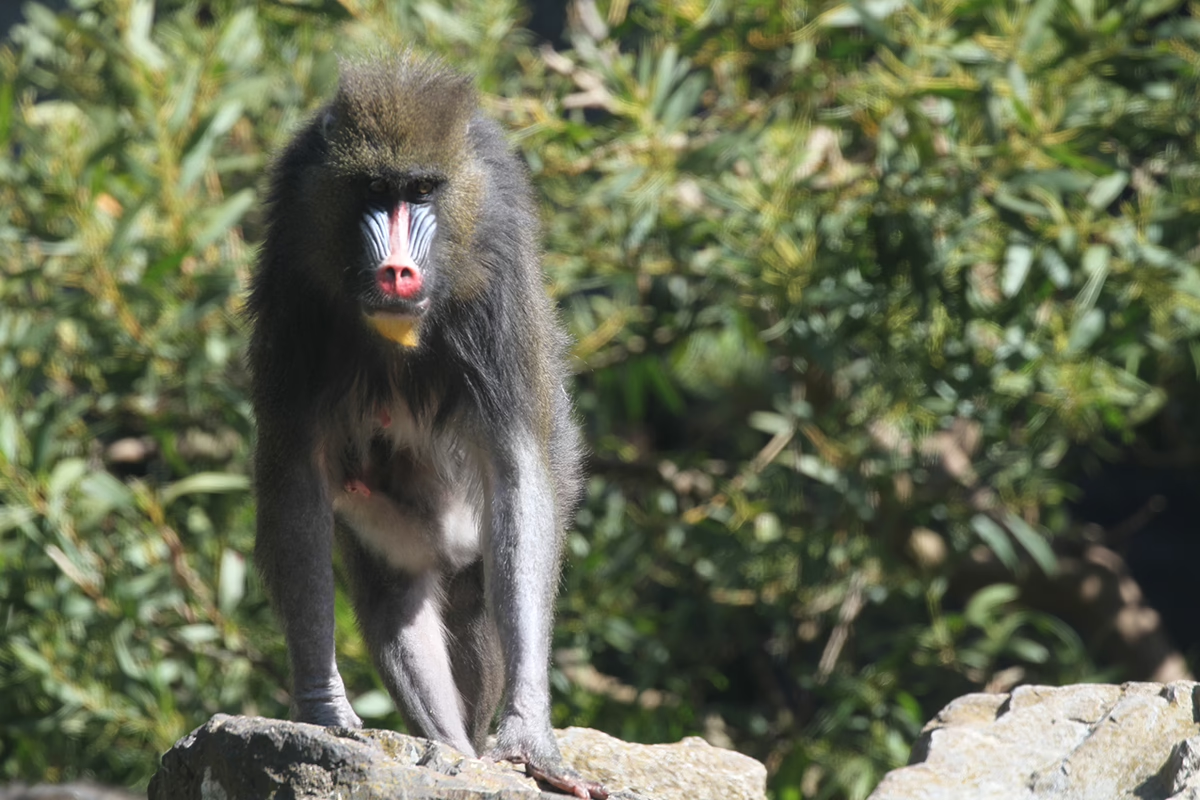
24-year-old Lulu passed away following procedure
Lulu, a 24-year-old female mandrill and beloved, long-time resident at San Francisco Zoo and Gardens, died yesterday. Her passing followed a procedure to reevaluate a myriad of conditions—some of which had worsened—and to evaluate a potentially cancerous mass located in her neck. Despite life-saving efforts, including CPR and advanced life support, she passed away shortly after her examination.
“Our mandrill troop, her caretakers, and the Zoo community are mourning Lulu’s passing,” said Dr. Adrian Mutlow, Executive Vice President of Animal Health & Wellness. “As an older mandrill, our animal care, behavior, and veterinary teams had been closely monitoring Lulu for the past year after she was diagnosed with anemia, chronic kidney disease, spinal lesions, and abnormal blood calcium levels”
Although complete results are not yet available, initial blood tests indicated her anemia remained unchanged, her kidney function had worsened, calcium levels had significantly increased, blood sugar was lower, and potassium levels were dangerously high. Considering these findings, the veterinary team decided not to prolong the anesthesia and proceed with the mass removal.
“She died shortly after being returned from the Zoo’s hospital to the mandrill night quarters, despite our efforts to revive her,” said Mutlow. “Here, the other mandrills in the troop, including her three offspring, were allowed a grieving period where they could be close to her one last time. Although she still ate and acted normally with her troop, animals can be surprisingly stoic. This exam and Lulu’s preliminary lab results revealed she was much sicker than she seemed before the examination.”
Lulu was born at the San Diego Zoo on July 24, 2002. Her keepers threw her a special 24th birthday celebration this year, allowing her to have “first dibs” on her favorite treats, including popcorn, dried cranberries, and yams. She arrived at the Zoo in late 2004 to join the mandrill troop at the Primate Discovery Center. She and Big Joe, a now 16-year-old male, produced three offspring together: males Kiburi and Johari, and female Benny. Along with a pair of older females, they made up a successful family troop.
“She was an excellent and caring mother,” said Kyle Runzel, Curator of Primates. “She was extremely gentle and protective, and was a true favorite among her caretakers, staff, and volunteers. We were so lucky to have her in our lives. It was her quirkiness that gave Lulu her charm. She was quite a unique mandrill.”
Mandrills are the world’s largest monkey species and are classified as Vulnerable by the IUCN, indicating that they are at risk of extinction in the wild. In their native Africa—where they are found in the subtropical forests of southwest Cameroon, western Gabon, Equatorial Guinea, and southwest Congo—their populations have seen a 30% decline over the past 30 years. Males are distinguished by their bright facial colorations and brightly colored rear ends, while females have less colorful faces, ranging from dark pink to black. Similar to baboons, male mandrills have stocky, powerful bodies and muscular arms, and they are significantly larger than females.
“Lulu was a beloved member of her troop and an amazing ambassador for her species and the conservation challenges it faces,” said Runzel. “Her animal care team, fellow mandrills, and all who knew her will miss her deeply.”
The life expectancy for mandrills is 12 to 20 years in the wild, and 30 years or more under human care. The Zoo previously lost Angie, a female mandrill who passed away last year at 35 years old—at the time, the oldest female mandrill in zoos. The mantle for the oldest in North America is now held by Dora, another of the Zoo’s females, who turned 34 earlier this year.
Tin tức và blog

Blog post title lorem ipsum dolor sit
Sed tincidunt quis amet ut. Augue et pellen tesque quis sit tempus placerat vitae. Nunc potenti donec blandit quis sit.

Blog post title lorem ipsum dolor sit
Sed tincidunt quis amet ut. Augue et pellen tesque quis sit tempus placerat vitae. Nunc potenti donec blandit quis sit.