





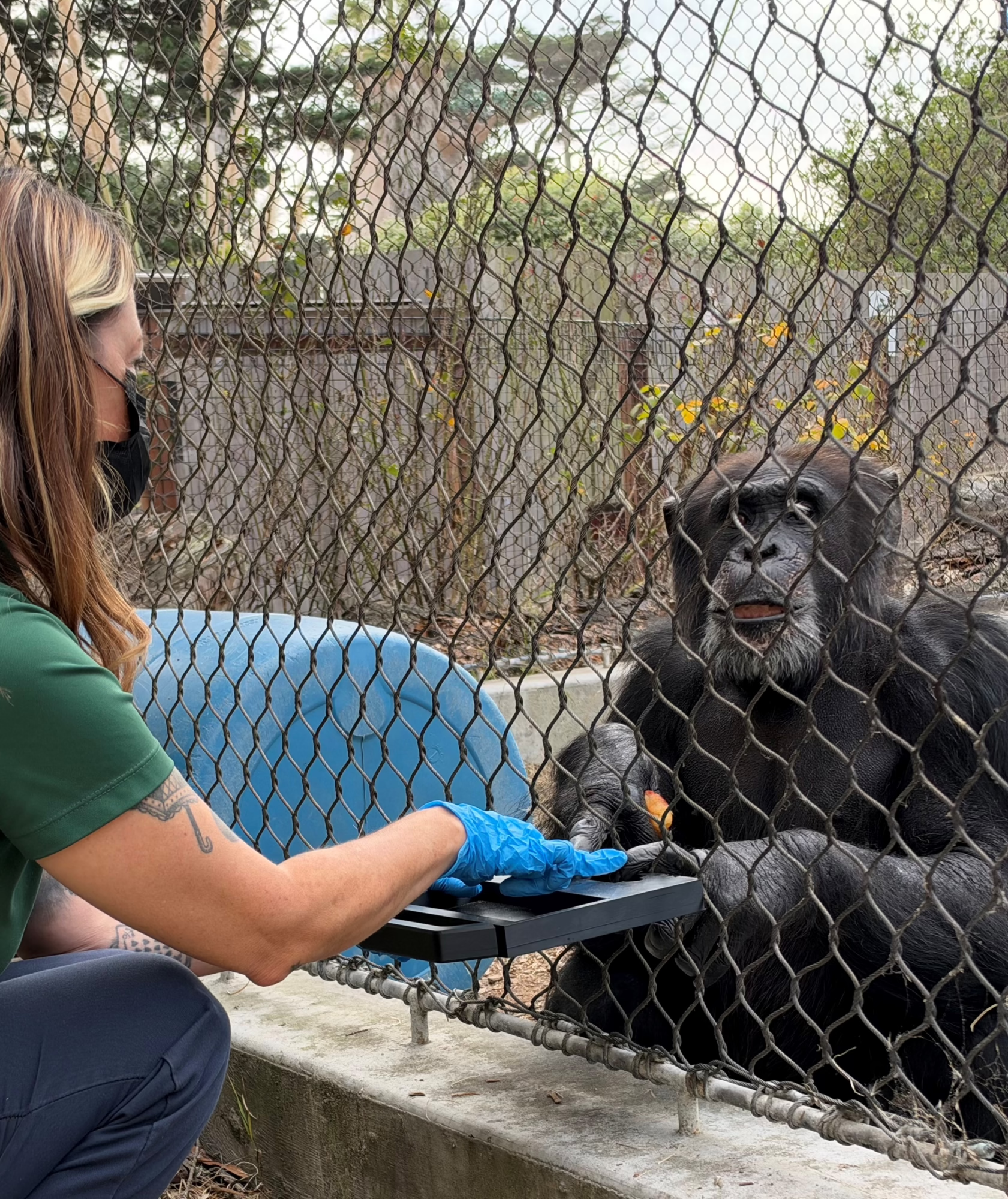
By Matt Treppiedi, Director of Behavioral Husbandry, Cheyenne Coles, Primary Chimp Keeper
At least, for Qadeer! Qadeer is our 41-year-old male chimpanzee (Pan troglodytes). You may notice that some of his fingers are substantially shorter than others. Qadeer lost some of his fingers throughout his life; this is not an uncommon circumstance when chimpanzees have heated exchanges.
Qadeer, (also known as Gombus), has adjusted well to life without all of his fingers. He can engage in all normal chimpanzee behaviors such as locomotion, enjoying various fruits and vegetables, playing with enrichment items like his firehose, and succeeding in complex training.
Here at the Zoo, we achieve training our animals various behaviors through a practice called positive reinforcement. This means that we reward, or reinforce, behaviors that benefit our animals in participating in their welfare. Behaviors such as voluntary injection (receiving a vaccine), stepping onto a scale for updated weights, and entering a crate/ transportation vehicle voluntarily are just some of the skills that are taught.
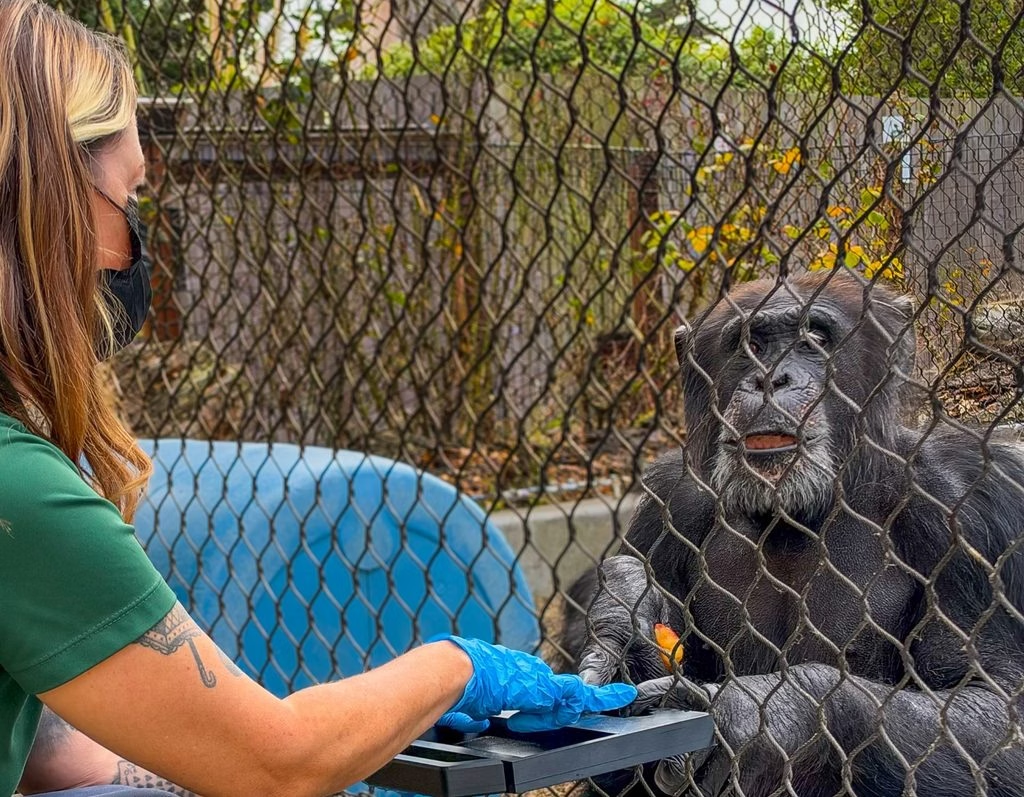
As chimpanzees age, their body systems change in ways similar to humans. To ensure our chimpanzees are in tip-top-shape as they grow older, we provide additional measures to collect health data. One device we have implemented to help acquire additional health data of our chimpanzees, and other great apes, is an electrocardiogram (ECG) sensor. This device measures the electrical signals that come from the heart and displays the data in a graph for visual interpretation. This device requires the placement of fingers on the sensor for 30 seconds to accurately detect electrical activity and chart it.
To use this heart monitoring device, we taught Qadeer to place the fingers he has through his enclosure and onto the sensors. The most difficult part is not teaching him duration on the sensor, it’s helping him figure out how he can get his fingers that reach to the device! Recently, Qadeer had a huge breakthrough: figuring out the finger orientation to place on the reader. At first, we reinforced him by presenting his hands to us (freeze-dried strawberries have been an effective motivator), then each time he placed the fingers we needed through his enclosure we reinforced him with a larger quantity. These moments of reinforcement communicate from us, the trainers, to Qadeer, the learner, that the behavior he completed was desirable. By using positive reinforcement (the addition of a desirable reinforcer such as strawberries) we increase the likelihood of the behavior occurring again. Qadeer’s frequency of correct behaviors has increased, and so has his consumption of strawberries!
Qadeer continues to make great strides in training. Teaching animals behaviors that enhance their well-being is a critical part of how to approach animal care. By allowing animals the choice to participate in training sessions, and to control what type of reinforcers are used based on their individual preferences, we foster a highly positive and enriching opportunity to connect with one another, species-to-species.