





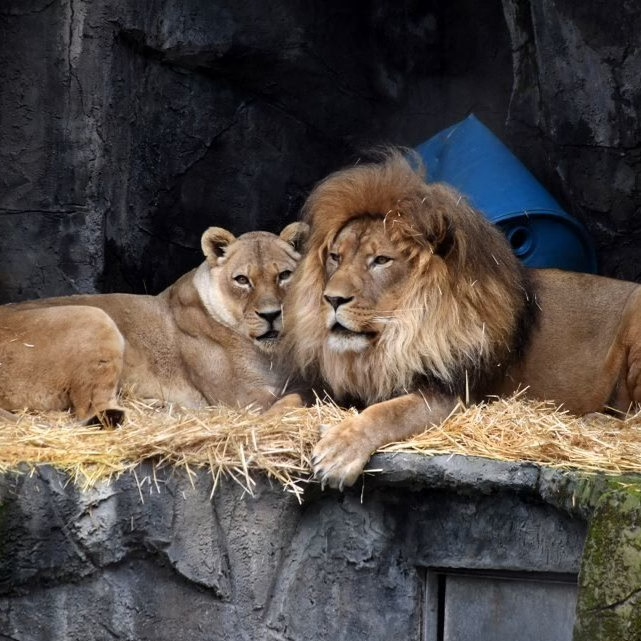
Beloved lions’ new home features 3 facilities with a combined 40,000 acres
This past May, San Francisco Zoo & Gardens announced that it would be transferring its remaining African lions to a new home to better support their welfare needs as they age. When seeking a new home in conjunction with the Association of Zoos and Aquariums’ Species Survival Plan (SSP) for African Lions, one of the main requirements was that the facility be either an accredited institution or an SSP-vetted and approved wildlife sanctuary. Today, the Zoo has announced that its 11-year-old male Jasiri, and 12-year-old female, Marvella (also known as Lulu) will transfer next year to the Wild Animal Sanctuary in Keenesburg, Colorado.
“Because of the age and health of Jasiri, who suffers from a genetic spinal condition, and our desire to move him with our female, Marvella, as a bonded pair, our options were limited as we found that most accredited zoos could not accommodate two older animals,” said Roger Sweeney, Chief Animal Officer. “We made the decision to further explore the sanctuary option, and 10 times out of 10, the Wildlife Animal Sanctuary came up as the best facility.”
In May, the Zoo made the difficult decision to find a new home for the lions, as their current habitat at the Lion House has been earmarked to future-house Giant pandas. Although the arrival of the pandas has not yet been officially confirmed, the Zoo decided to rehome the lions because the historic structure was deemed no longer adequate for the aging pair. In particular, Jasiri requires flat surfaces to navigate safely due to his spinal condition. The current outdoor grottos contain uneven, rocky plateaus, presenting physical challenges for the aging pair.
Over the past year, Zoo officials worked closely with the SSP to determine options within accredited facilities while also holding talks with officials at the Wild Animal Sanctuary. With choices becoming fewer, the Zoo determined in October that the sanctuary would be the best solution. Contributing to the decision, was its history of working with other accredited zoos, that it is well-funded, and consistently ranks among the country’s top animal welfare non-profit organizations.
“Importantly for us, is that the facility has spacious enclosures, and flat, naturalistic surfaces to accommodate Jasiri’s condition,” said Sweeney. “They can also continue our physical therapy and rehabilitation that Jasiri receives here, and he and Marvella can remain a bonded pair.”
Under the agreement, the lions will still be owned by the Zoo on a loan basis. In this way, the sanctuary will be required to provide reports and updates to the Zoo to keep them abreast of how the two are faring.
“In the future, when we bring back our Big Cat program in an all-new, modern habitat, we will likely not bring back these lions, however, we want to keep that option available,” said Sweeney. “Though the Zoo has successful housed senior lions and tigers in the past, we want to do what’s best for Jasiri, and we believe we have found the best solution.”
Background
The 1940’s era WPA-constructed Lion House is home to Marvella, who came to the Zoo in 2023 from the Lee Richardson Zoo in Kansas, while Jasiri was born at the Zoo in 2015. At just one-year-old, Jasiri was diagnosed with a congenital spinal condition that affected his strength and coordination. Because corrective surgery carried significant risks, he instead has received on-going physical therapy and dedicated care from the Zoo’s veterinary and animal care teams throughout his life. After working extensively to identify another area of the Zoo to place them, it became clear that it was not feasible to build a new habitat for lions at this time, and other existing areas cannot adequately house big cats safely and securely.
With African lions under human care typically living 15-20 years, both Marvella and Jasiri are entering their senior years. While both lions remain agile and mobile, they are starting to experience some mobility challenges. Even in old age, animals should be given choice, comfort, and control over their lives.