
Toco toucan
Ramphastos toco
In the Zoo
South American Tropical Aviary Building
Fascinating Facts
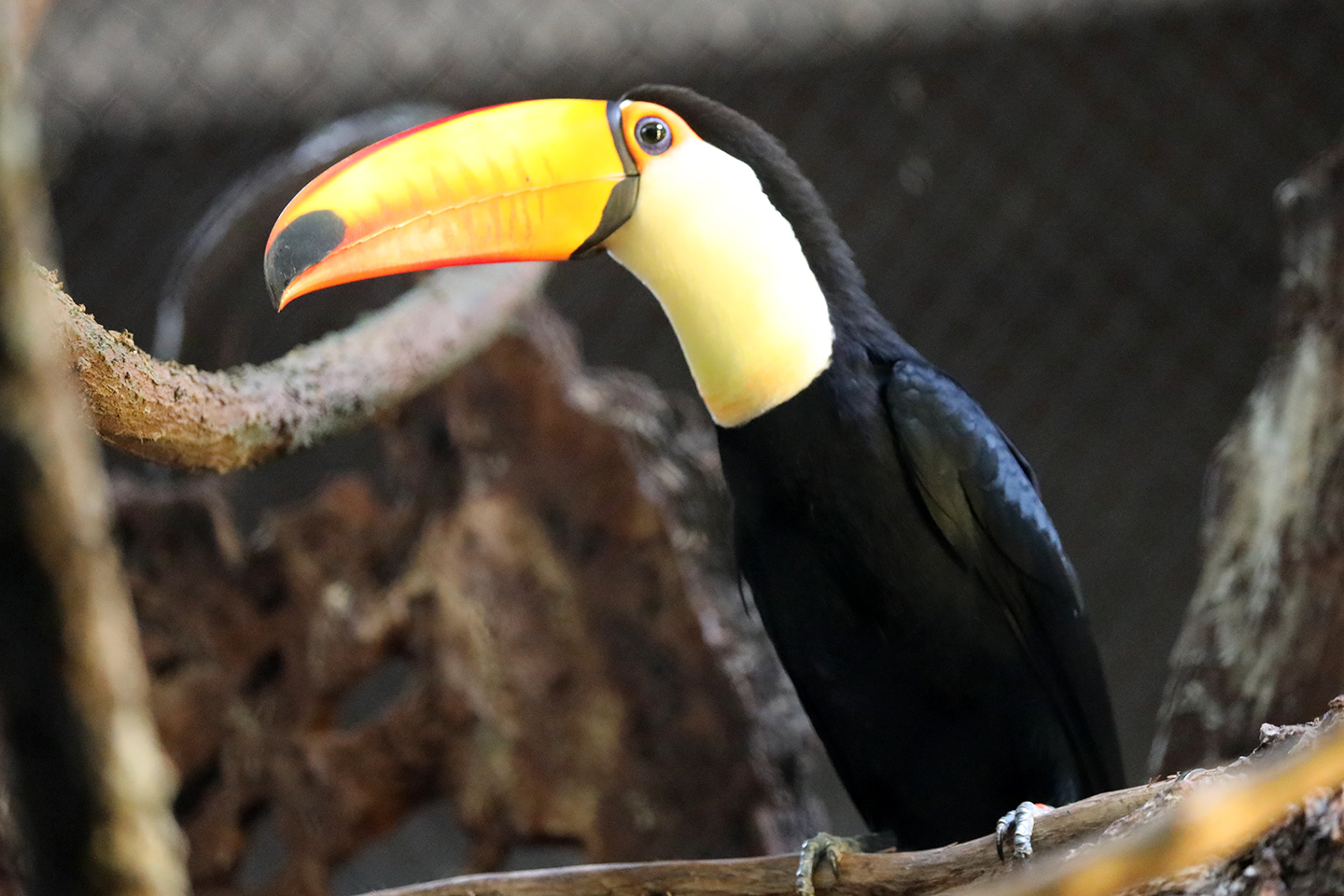
Toco toucans are also known as “giant toucans” and are the largest of all toucan species. They are a familiar sight, appearing as cereal mascots and in beer advertisements. Scientists aren’t entirely sure why they have such large bills. Theories include: for courtship rituals, to reach and peel fruits, as a weapon or deterrent to aggression, or to regulate heat. The bill is lightweight and made up of keratin – the same material in human fingernails and hair.
Physical Characteristics
Toco toucans are 25 inches in length, including 7.5 inches of bill. They have the largest bill to body ratio in the bird world. They weigh almost 2 pounds and have a red-orange bill with a black spot on the tip, a mostly black body with a white chin and chest, with black, white and red tail feathers. They have a violet ring of skin around the eye surrounded by an orange ring of skin. The iris is brown. Males are slightly larger than females.
Diet
They feed primarily on fruit, but will also eat insects, eggs, and chicks of other species.
Habitat
They are found in woodland near rivers, savanna, and shrubland.
Range
Toco toucans are found in northeastern South America, including parts of Guyana, Suriname, French Guiana, Brazil, Peru, Bolivia, Paraguay and Argentina. https://www.iucnredlist.org/species/22682164/281011279
Social Behavior
Toco toucans are monogamous during breeding season and will nest in a tree cavity. 2 – 4 eggs are laid and incubated by both parents for 17 – 18 days. Chicks fledge in 6 – 8 weeks. Chicks are born with a small bill – the distinctive large bill can take up to a year to grow to full size. Toco toucans feed individually or in small flocks of up to six members. They have an array of vocalizations that include grunting, croaking and clacking. They become sexually mature at 3 – 4 years and can live up to 20 years.
Status In The Wild
IUCN – Least Concern
Other
Threats to toco toucans include being hunted for food and captured for the pet trade. Predators in the wild include jaguars, snakes, coatis and eagles.