By Nancy Chan, Director of Communications
San Francisco Zoo’s storied past is a delightful procession of unique personalities—unconventional characters who became true legends over time.
A few legendary figures truly define the zoo’s human history. First is the iconic big cat keeper Jack Castor, the self-styled “king of the big cats” who spent a 48-year reign transforming the daily Lion House feedings into must-see spectacles. Then there is penguin keeper Jane Tollini, whose identity became completely intertwined with her beloved Magellanic penguin colony. In the 1990s, she gained global notoriety by launching the adults-only Valentine’s Day Sex Tour. This wildly popular edutainment event quickly made her one of the most recognizable faces of the Zoo.
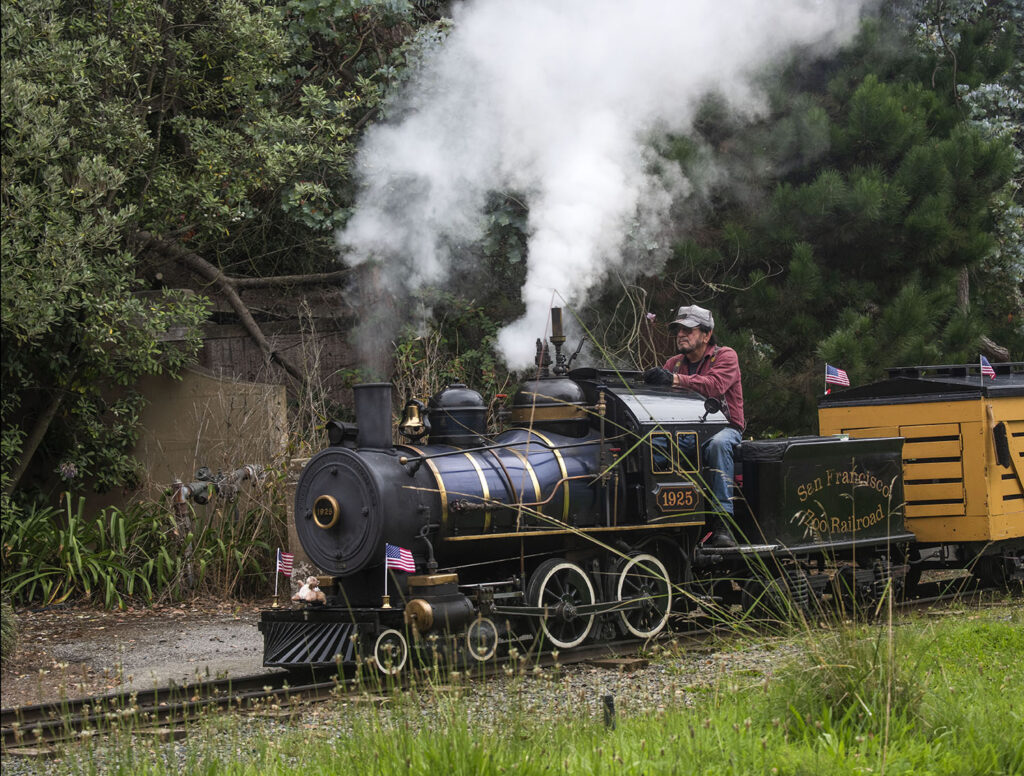
More recently, the mantle for the most eclectic and unapologetically authentic character at the Zoo belonged to none other than train engineer Johnny Sala. For a quarter of a century, Johnny operated the Little Puffer miniature steam train, turning every single loop around the tracks into a performance highlighted by tooting Puffer’s whistle and utilizing the actual boiler steam to create an authentic steam engine experience for everyone on board.
Upon retiring this past June at the age of 86, Johnny left behind a legacy of old-school humor and a gritty, well-lived life. He stands as a true testament to a bygone era—a man inspired by the music of Fats Domino and Elvis Presley, who was driven to school by some of the original Hells Angels, and who still happily gets by with a well-worn flip phone.
“I’ve lived more life than many,” said Sala. “I swam in the old Fleishhacker Pool, played at Playland at the Beach, and visited the Zoo in the 1940s and 50s. I even rode Little Puffer as a boy.”
Born in San Francisco in 1940, Johnny was a true “city slicker” until the age of 12, when his family relocated to Elko, Nevada. Though he was initially a fish out of water, he quickly learned to love the wide-open spaces, the rugged natural landscape, the herding of cattle, and riding horses. Johnny had become a cowboy, and he never looked back.
“It was the best time to be alive,” Sala recalled. “I found my place, and it dictated how I lived the rest of my life.”
As a teenager, Johnny discovered music. His passion began with traditional Western tunes but quickly evolved into playing rock ‘n’ roll/rock-a-billy that he still plays to this day. Mastering guitar and fronting his band the Rockin’ Rascals (later called the River Rats Band) that played honky-tonk and stagecoach clubs all around Elko, he connected deeply with the community through his music. It was on those stages that he truly became a lifelong entertainer—cracking unfiltered jokes, commanding the room, and making people smile.
“I played to cowboys and cowgirls, there was nothing in between,” said Sala.
His day job was laying tracks, ties, and trestles as a “gandy dancer”—a slang term for railroad workers who laid and maintained tracks by hand—for the Western Pacific Railroad. This stint was often grueling, physical work, where workers camped out for a week at a time, but it was where he learned about trains and his craft. Before long, he moved back to San Francisco, working briefly pumping gas at Standard Oil, known then as full-service stations. He met his wife in Elko, and together they had three sons (he also has a daughter with another woman, but that is another story).
Through the height of the ’60s and ’70s, he worked installing and repairing pinball machines. Pinball machines were found in every bar in the City during an era when early machines were considered illegal gambling devices.
“Cops would turn a blind eye,” said Sala. “These were games of chance, not skill, and people could win money and prizes by playing them. So, they were outlawed, but bars still offered them. In those days, San Francisco was a cool city, like the old west without the horses and cattle.”
His persona was also defined by his love of riding Harley-Davidson motorcycles, which began in 1954. The original Hells Angels was a motorcycle club founded by World War II veterans, and they would give Johnny rides to school as a youth. The thrill of these rides stayed with him. acquiring his first Harley in 1961. He never got into the later Hells Angels notoriety, and simply loved to ride motorcycles. Today, he alternates that mode of transportation with his still-pristine 1941 Plymouth, which he and his son restored. He says it still “runs like a dream.”
His relationship with the Little Puffer began in 1997, when the Zoo’s Chief Operating Officer, Jim Lazarus, resurrected the long-forgotten miniature steam train as a new revenue source for the zoo. The historic train had originally run for over 50 years starting in 1925, but it was eventually moved to the Pachyderm Building to make room for Gorilla World. There it sat for nearly a quarter of a century. During its exile, Asian elephants Pennie and Tinkerbelle—later joined by a third female, Calle—took turns throwing debris at it from across their indoor enclosure. Though decaying and in rough shape, the old train still held potential for a brand-new life.
Thanks to Don Micheletti, leader of the locally-based Golden Gate Railroad Museum (GGRM) and the generous support of the Goldman Foundation, Little Puffer was brought back to life by volunteer train enthusiasts who welcomed the restoration of the “little engine that could” as a worthy challenge.
Johnny Sala was among those dedicated volunteers, donating his time, energy, and railroad expertise to the project.
“It was fun and exciting to work on Puffer,” Sala said. “We restored it and kept everything that was on it. Some of the train had actually been rebuilt in 1975. We did not intend to bring it back to its original 1905 form, but simply to get it working again. What was brand new in 1998 was the headlamp and the sand dome on top of the engine, which we fabricated ourselves. It took nearly 10 months, and we were so proud of the work to bring Puffer back to life.”
The Little Puffer was reintroduced with a new train depot, freshly laid track, and much fanfare in 1998. Initially, Johnny and other GGRM volunteers took turns coming to the zoo to operate the train. Then, in 2000, Johnny took a permanent job running the Puffer alongside his longtime colleague, Bob Swanson, who also worked to restore Puffer. The duo worked side-by-side until Bob’s retirement in 2018.
“Between us, we had a great time making kids and families smile,” Sala recalled. “It really was a golden era, and it was great to create memories for so many.”
While it is hard to estimate how many loops Johnny made around the tracks, he always remembered the pure joy of talking to guests, sharing stories, and connecting with visitors.
“I made jokes, and of course, unlike my honky tonk days, these were now filtered,” Sala said with a grin.
Johnny became synonymous with Little Puffer, recognizable in his characteristic plaid shirt and suspenders and blue jeans with the big belt buckle. He knew many of his “regulars” and guests would call out his name when they saw him.
His many co-workers have described him as both eclectic, outspoken and dedicated to his craft. Over the years, he played music for many Zoo events, and did so with his trademark humor and gusto.
A few years ago, the Zoo decided to relieve the historic Little Puffer of its daily grind. A new diesel train was introduced, nicknamed “Cobby,” named in honor of the beloved, long-time zoo resident and North America’s oldest male chimpanzee, who passed away in 2021. Because the Cobby train required a different style of track system, the zoo utilized the transition to launch a project expanding the route by 1,000 feet, offering fresh views of Bear Country and the upper lake.
Meanwhile, Johnny and his fellow engineer, Walt Hutchins, kept busy with maintenance but stepped back from operating the new diesel locomotive.
“I realized that, at 86, it might be time to move aside,” Johnny said. “I will miss working on Puffer when it requires service, but I will mostly miss making people smile.”
Check out his 2023 interview on KTVU’s Hella Cool Gigs
Throughout his zoo career, Johnny touched a lot of people. One of those individuals was Kiante Hirosuke Muza Braden, who wrote this piece about Johnny in April 2026.